T E C H N O L O G Y
One roof plane. Three jobs.
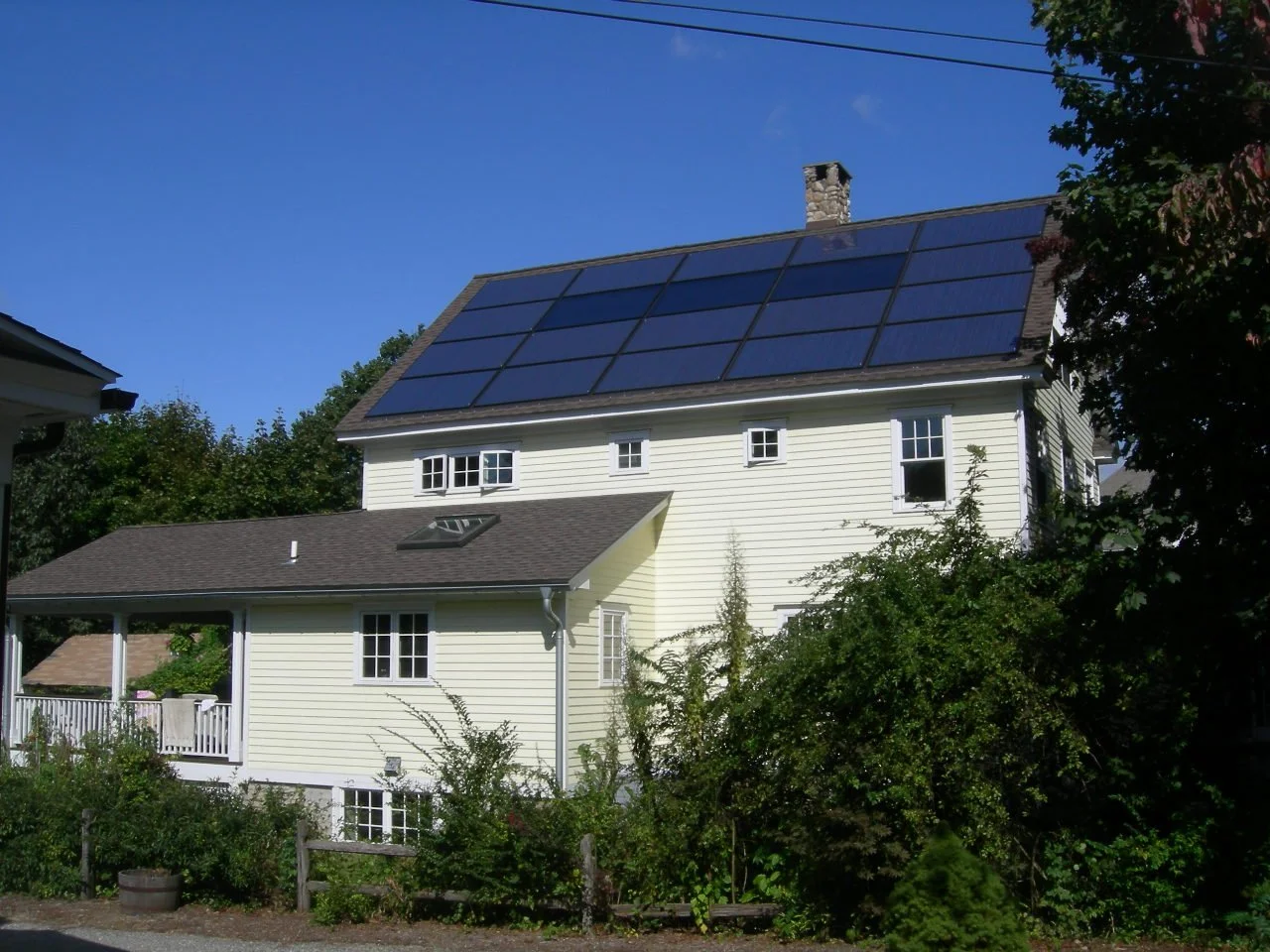
Conventional construction stacks a roof membrane, then racking, then solar — three systems, three costs, one function each. The Energy Roof integrates everything into a single factory-panelized assembly.
Weatherproofing
Flush glass-and-silicone outer skin — no exposed metal, no separate membrane. The panel is the finished roof surface.
Solar electricity
Glass-on-glass monocrystalline BIPV across the roof plane (~180 W/m² usable), sized to the building's footprint.
Heat-recovery ventilation
Smart fans, ducts & dampers in the underpanel plenum move heat where it helps: out in summer, in during winter
E N G I N E E R E D, N O T A S S U M E D
CFD-validated thermal design
A nine-run conjugate-heat-transfer (CFD) campaign swept 1.5”, 3” and 4.5” air gaps across summer fan-on, fan-off stagnation and winter operating modes. The 3-inch plenum was selected: the 1.5” gap matched its heat capture at roughly four times the friction, while the 4.5” gap slowed the air so much that it halved the thermal harvest. The model was then rebuilt on the full 28 ft × 16 ft (7 × 4) prototype geometry and driven through 8,760 hours of representative Connecticut weather. Full-scale instrumented validation (thermocouples, heat-flux sensors, airflow) will follow on the prototype.
SYSTEM SNAPSHOT
-
4' × 4' interlocking, factory-built
-
Glass + silicone, flush, low-slope tolerant
-
3 in. — CFD-optimized
-
~180 W/m² rated; ≈ 9,300 kWh/yr of electricity from the 28-module prototype
-
Solar-heated recirculated air for the house (winter); captured heat and active heat rejection (summer)
-
35% of incident sun put to use at the summer design hour (7.4 kW heat + 6.1 kW electricity); 23% over a full year vs 13% for PV alone
H O W I T W O R K S
One plenum, three operating modes.
Beneath the glass-on-glass laminate runs a continuous 3-inch air plenum across the full roof width, above a 5/8-inch deck and 9.25 inches of insulation. In summer, a fan draws outdoor air in at the eave and out at the ridge, sweeping heat off the back of the panels. With the fan off, the open eave and ridge let the roof vent itself as a solar chimney. In winter, the plenum runs as a closed loop on 68 °F indoor air, and a differential thermostat runs the fan only when the roof is warmer than the room.
S U M M E R P E R F O R M A N C E
Electricity and heat from the same hour of sun.
At the summer design hour (89.6 °F ambient, 1,000 W/m² of sun), outdoor air drawn in at the eave by a 1,139 CFM fan reaches the ridge at 111 °F — a 21 °F rise — carrying 7.4 kW of heat on top of 6.1 kW of PV electricity. Together that puts 35% of the incident sunlight to use. A larger 1,329 CFM fan would add only 0.5 kW of heat for about 60% more fan power, so the base fan stays: it returns roughly 25 W of heat for every watt it draws.
S A F E T Y C A S E
Fan off, full sun, still well within rating.
With the fan off under full summer sun and the eave and ridge open, the roof behaves as a solar chimney: buoyancy alone draws about 1,120 CFM up the 16-ft slope. The laminate settles at 140 °F on average, with a hottest point of 146 °F — 48 °F below the 194 °F continuous material-rating basis. With screened openings the peak rises only to 149 °F, and even the sealed bounding case, with dampers closed, holds at 157 °F. The summer openings are therefore specified normally open.
W I N T E R P E R F O R M A N C E
Free solar heat through the heating season.
From October through April, the closed loop runs about 900 hours per season and delivers ≈ 2,250 kWh (7.7 MMBtu) of space heat — roughly the heat in 65 gallons of fuel oil — using a 0.3 kW fan. In low-speed comfort mode (300 CFM), delivery air averages 76–83 °F by month and peaks near 109 °F on bright days. A standard differential thermostat keeps the fan off during the few hours the roof can’t beat room temperature, and the panels keep generating all winter: about 2,540 kWh of electricity from November through February alone.
T H E A N N U A L P I C T U R E
Nearly double the useful energy of a PV-only roof.
On identical sun — 72,420 kWh per year striking the prototype’s 38.8 m² active area — a conventional PV-only roof returns about 9,300 kWh of electricity, or 13%. The Energy Roof returns ≈ 16,950 kWh of useful energy, or 23%: the same electricity plus 5,400 kWh of summer heat and 2,250 kWh of winter space heat, for the added cost of a fan, dampers and a controller.
All figures are modeled with a finite-volume conjugate-heat-transfer analysis, using convection correlations measured on full-scale air BIPV/T channels and a representative Westport, CT weather year. They will be confirmed by instrumented testing of the full-scale prototype.